
What business does not do social media these days? Probably none. But do these businesses know how to — better yet actually do — get a return on their efforts? Further, how much are they maximizing the benefits of their social media presence?
Social media has become part of everyone’s daily life that many think the work involved to be perfunctory. The different platforms allow any and most content types after all. Indeed, with new tools and technologies, AI in particular, creating content for social media has become less intimidating and less time-consuming.
Anyone with an internet-connected device and social media platform can run a campaign. No complicated strategizing nor planning required.
But with so much content coming out vying for user’s shorter attention span, is it really that simple to be on social these days? Has it become much easier to stand out on social media?
How does one cut through so much clutter and din and actually get noticed? How do brands get traction on their social?
The power that is social media
Social media numbers have continued climbing, and they will remain on an uptrend for years to come. The numbers alone reflect this strong power.
There are now 5.66 billion social media users globally. That is nearly 70 percent of the total population worldwide and 94 percent of total internet users, according to Kepios.
New social media user identities added to the different platforms in the last 12 months numbered about 259 million. That means about 8 new users are added every second.
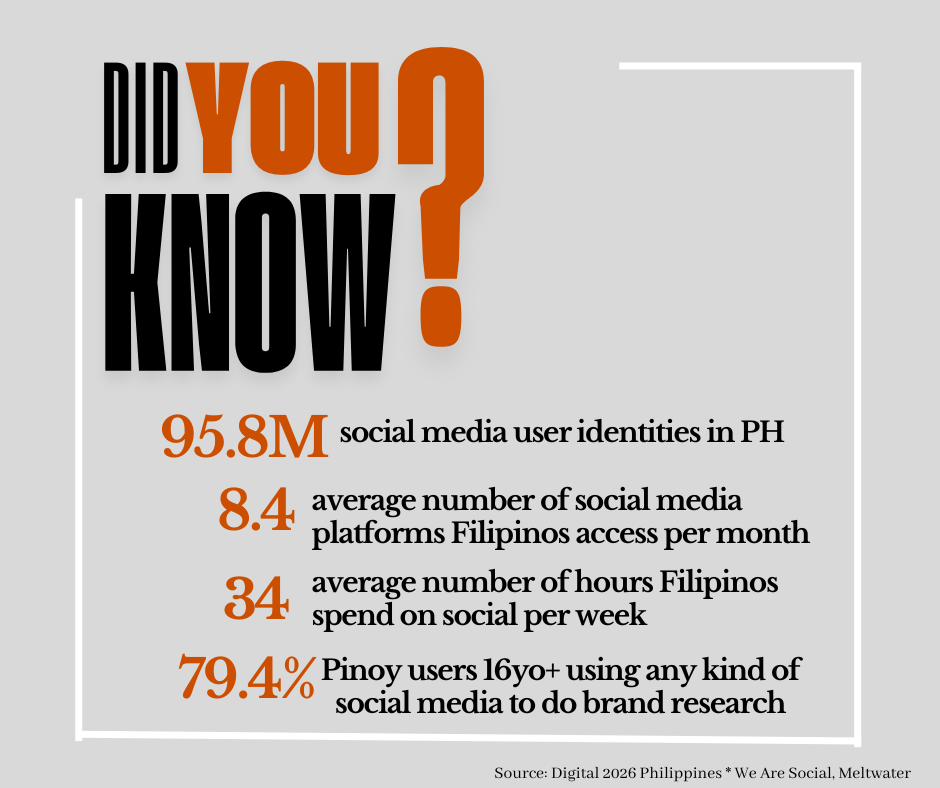
In the Philippines, the social media capital of the world, user identities are currently at 95.8 million or 82 percent of the total population, according to the Digital 2026 Philippines report by We are Social and Meltwater. User identity numbers grow by 10.3 percent YoY.
Filipino social media users access 8.4 platforms on average per month and spend on average nearly 34 hours on social media per week.
Despite internet connection limitations in many parts of the country, the Filipino social media user population is projected to keep growing. Statista forecasts 2029 numbers to reach 122.14 million.
Locally and globally, social media users are now considered a supermajority. They outnumber non-users two to one, noted We Are Social and Meltwater. Even with tightening regulations, social media adoption will not likely be stymied.
Shifts and trends shaping social media
Social media mirrors the society and its seasons even as it also adapts to the world outside of it. In this sense, it is not static and invariable.
User needs and expectations evolve and new technologies and platforms emerge. Platforms are evolving alongside these shifts not just to adapt but also to increase usability and relevance.
Here are some developments that have taken shape in recent months and that will influence social media going forward. They will also impact how companies and brands approach their social media strategies.
- Social media is a key business driver.
- Social media is a news and information hub.
- Social media is a search engine.
- Social media is an e-commerce space.
Social media is a core business driver and tool. In the past, businesses would treat social media as a supplementary PR or marketing space. Now, social media is viewed as very integral to business performance and success.
It has moved to the center of things. It has become a major product discovery and purchasing channel for many companies. Smaller businesses that find PR and advertising budgets prohibitive start with social media, leveraging its easy and less costly access to create awareness and promote products or services.
More than 50 percent of social media users aged 16 and above used social media to seek out brands in Q2 2025, according to the Digital 2026 Global Overview report by We Are Social and Meltwater. For the same period, 72.3 percent of internet users 16 years old and above turned to social media to research brands and products they are thinking of purchasing.
Social media ads have become a major source of information about products and brands, especially for younger users. In response, advertising spending by business on social media has been on the rise. This year, social media advertising costs are forecast by Sprout Social to hit $317.33 billion.
In the Philippines, the estimated annual spend on social media advertising is US$679 million. This represents 32 percent of total digital advertising spend, according to the Digital 2026 Philippines report. The YoY change in social media ad spend is at +14.5 percent or at least US$86 million.
Social media is the go-to for news and information. Social media platforms are the new news channels. It has replaced TV and print publications. (Further reading on the decline of traditional news sources and impact on PR here.)
More users now go to YouTube for their evening news or to X for real-time updates on current events. TikTok, initially mainly for entertainment, has recently become a top destination for news and current events.

Among Filipinos, social media is no longer just a means to connect with family, find old friends or network with colleagues. It is now a main source of news.
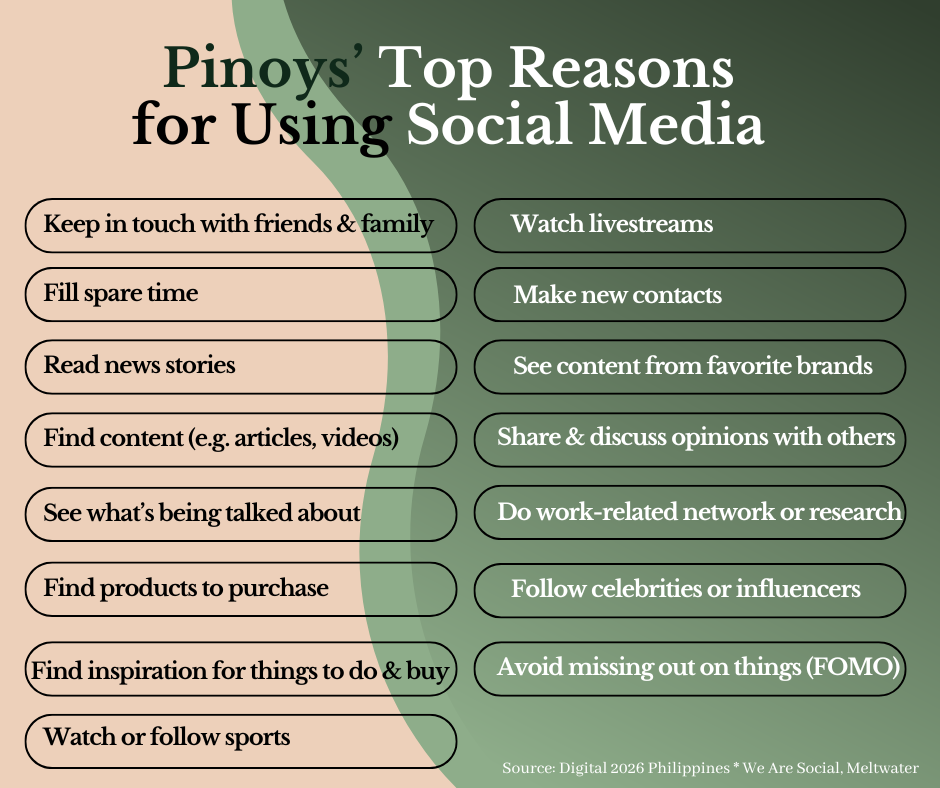
Thirty-five percent of Filipino social media users aged 16 and above ranked reading news stories as a top three reason for using social media, as revealed in the Digital 2026 Philippines report. Consuming other content and getting updated on top issues and trends follow quite closely.
The flow of information is also shifting. Individual Filipinos are sharing news on their social media platforms, making their personal pages a potential source of news for others as well.
What do these mean for businesses and brands? With information still currency, being a source or hub of relevant and updated information makes companies invaluable to their target audience. How to do this?
- Leverage social media platforms to update followers on company developments, products, launches and other such milestones.
- Do not stop there: Demonstrate domain knowledge by covering market trends and issues once in a while.
- Companies can even build on thought leadership with posts about accomplishments, research or findings, all under the umbrella of news sharing and not hard selling.
Social search is transforming traditional search. Beyond getting updated on news and current events, social media has become a major tool for searching just about any information. Yes, social media is now also a search engine.

Researching products and brands, either to purchase or for inspiration, is among the top reasons Filipinos go on social media. Entertainment, in particular sports and livestreams, and inspiration likewise spur social media use.
Eighty percent of Filipino netizens 16 years old and above that use social media to gather information about products and brands do so using any kind of social media, according to the Digital 2026 Philippines report.
More consumers, younger generations especially, are going directly to TikTok, Instagram and even YouTube to get product information through unboxing, demos and reviews. The platforms’ content serves as a guide in their purchasing decisions.
Brands must then design their social media content in such a way as to be visible to both traditional search engine results pages or SERPs and AI search results and summaries.
- If employing AEO or answer engine optimization for the website, extend the same to social media content.
- Add keywords in captions and titles. Click-bait titles might hook the audience but might not work with AI assistants.
- Explore using questions on both the caption and on-screen text to generate interest.
Our previous article on Optimizing Content for SEO and GEO: More Strategies and Tips might offer additional tips.
Social e-commerce is growing rapidly. With so much time spent on social media daily and the different platforms being a research hub on products and brands, doing actual purchase transactions on such platforms sort of naturally follows. Being able to do practically everything on a single platform is highly appreciated by netizens.
The Philippines ranks high on online shopping. The country’s revenue from social e-commerce is estimated at $2.30 billion in 2025 and could hit $4.17 billion by 2030, according to TrueLogic.
The combination of entertainment and shopping — or shoppertainment — on sites such as TikTok, according to Truelogic, has both high appeal and value.

Social e-commerce is changing how brands utilize social media to interact with consumers. Shoppertainment more so because now brands must offer content that is fun and drives sales at the same time as opposed to merely selling products on social media pages.
This could mean a shift in overall content strategy, even social media advertising and digital marketing. Adding online shopping to one’s social without compromising content can be a challenge.
Further, enabling purchase transactions directly on one’s social media pages would involve looking into payment setup, delivery and other logistics-related concerns.
The second part of this article will discuss the rest of the social media shifts and trends. Watch out for it.
Sources
https://datareportal.com/reports/digital-2026-philippines
https://www.truelogic.com.ph/blog/social-commerce-in-the-philippines
https://sproutsocial.com/insights/index
https://www.statista.com/topics/6077/tiktok
https://datareportal.com/reports/digital-2026-global-overview-report
https://sproutsocial.com/insights/social-media-statistics
https://insiderph.com/youtube-touts-stronger-ad-spending-roi-than-tv-social-media-in-ph