First Olympic Winter Games to Host its Core Systems on Alibaba Cloud

Olympic Winter Games Beijing 2022 has successfully migrated its core games technology services to Alibaba Cloud, the digital technology and intelligence backbone of Alibaba Group to bolster IOC’s digitalization efforts.

The migration occurred against the backdrop of the COVID-19 pandemic in order to create a safer, more efficient, sustainable and inclusive experience for participants and audiences from around the world.

“The Olympic Winter Games Beijing 2022 will be remembered not just for the excitement and the phenomenal achievements of athletes from across the world but also for the new benchmarks it had set to drive a more efficient, sustainable and inclusive Olympic Games,” said Jeff Zhang, President, Alibaba Cloud Intelligence. “We are proud to be supporting the digitalization of the Olympic Games and we hope our experience in hosting Beijing 2022’s core operating systems on Alibaba Cloud will be passed on to future sporting events.”

Advanced cloud capability to boost organizer efficiency

The International Olympic Committee and the Beijing Organizing Committee for the 2022 Olympic and Paralympic Winter Games (BOCOG) executed a master plan for the Olympic Winter Games. It includes the implementation of key operational systems delivered by the IOC’s Worldwide IT Partner Atos such as the Games Management Systems (GMS), Olympics Management Systems (OMS) and Olympics Distribution Systems (ODS). These have all been migrated to Alibaba’s cloud infrastructure.

The Olympic Winter Games Beijing 2022 has realized a further move to cloud-based services, further reducing the time and cost investment on IT infrastructure, hardware and associated management. With the advanced cloud-based capability to analyze real-time intelligence, the planning and management for Beijing 2022 was further streamlined and improved for more seamless user experience.

Taking advantage of the scalability, reliability and security features of the cloud infrastructure, event organizers such as the IOC can reduce the complexity of the game planning based on intelligence-driven decisions, striking for the right balance between optimizing existing resources and creating new ones. That way, hosting cities can also reduce the time and costs associated with the legacy physical infrastructure investment upfront.

Cloud technology helps bring the world closer together

Beijing 2022 also showcased a series of technological innovations developed to bring more inclusive experiences for fans in multiple locations. Alibaba introduced Cloud ME, a cloud-powered realistic projection that facilitates remote social interactions. The technology defies distances by enabling people to meet and converse with each other’s life-sized, true-to-life persona projections.

In addition, Alibaba unveiled Dong Dong, a 22-year-old virtual influencer. Originating from Beijing, Dong Dong was created to interact with fans globally, sharing fun and informative Olympic-related facts. Speaking in a natural-sounding human voice, she can convey a range of emotions. This has proven to be particularly efficient for engaging with the younger audience. From February 4 to 20, Dong Dong’s livestreaming has been viewed by more than 2 million viewers with a fan base of more than 100,000.

To deliver the best Olympics content to a global audience, Alibaba’s cloud computing technology also powers the Olympic Channel Services, which brings high-quality programs to fans around the world to engage with the Olympic Movement anytime, anywhere and on any device.

Sustainable innovations for the future of Olympics

For the first time, the distribution of live signals of the Olympic Games over the cloud has been implemented, providing Rights Holding Broadcasters (RHBs) with agile and cost-effective options. Through the Olympic Winter Games, 6,000 hours of footage were produced by the OBS and broadcasted to more than 220 countries and territories.

The OBS Video Server, which was fully hosted in the cloud, provides RHBs with efficient and scalable system while reducing on-site hardware investment. With Content+, RHBs could access all content produced during the Olympic Winter Games, including the live coverages, remotely with ease. The implementation of OBS Live Cloud also provides an alternative to heavy investment for RHBs and the host cities, when the Olympic Games related contents can be transmitted over the public cloud, effectively reducing the carbon footprint of broadcasting related operations.

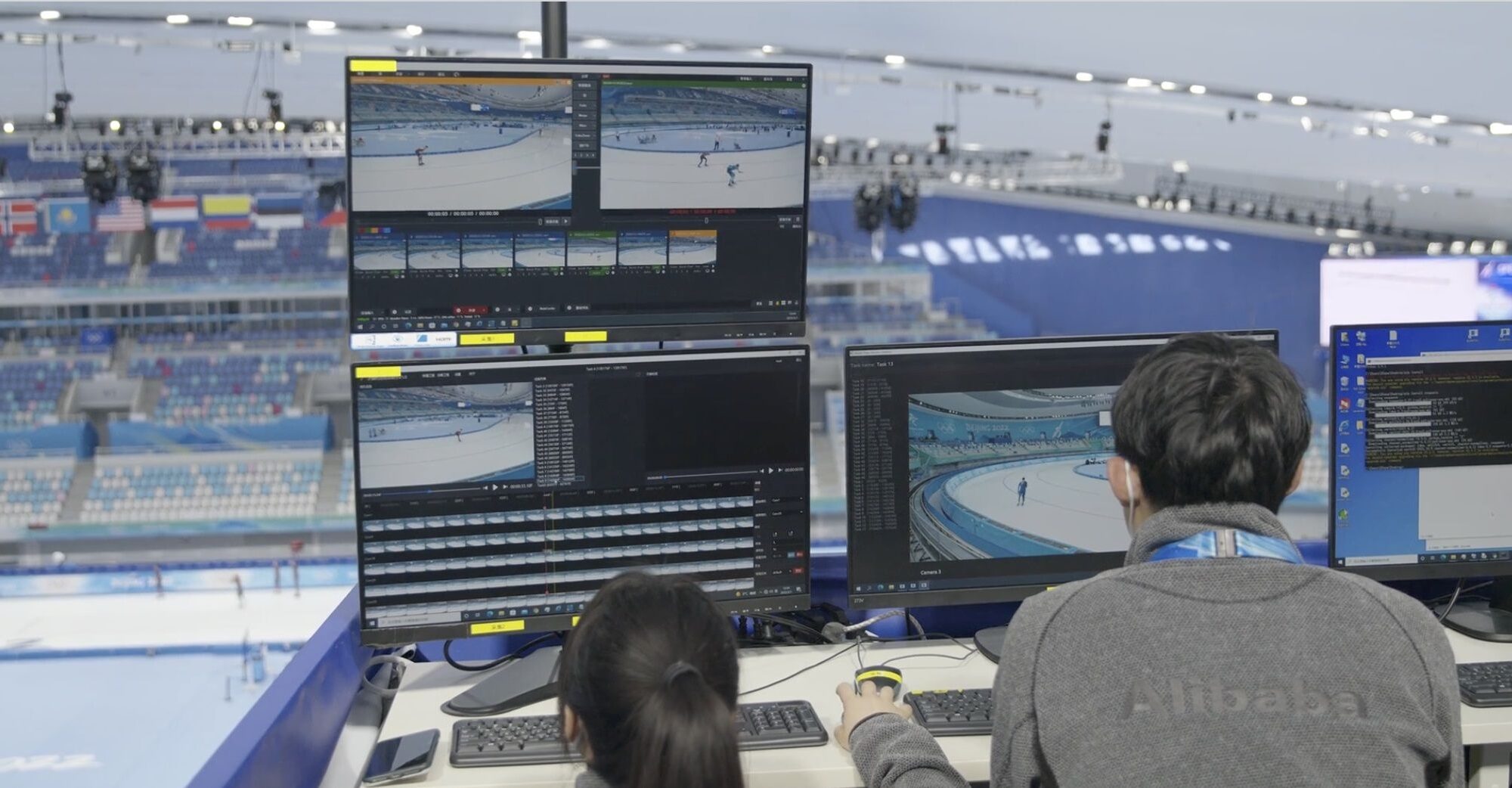
In addition, OBS also leveraged multi-camera replay videos with Alibaba, providing replays of competition highlights for curling and speed skating within seconds, bringing engaging and dynamic viewing experiences to audience around the world via RHBs on the cloud.

Ilario Corna, IOC chief information technology officer said, “Beijing 2022 should champion innovation as well as sporting success. I am thrilled to see that the cloud-based technology in action at the Olympic Winter Games not only benefits athletes, fans and operating staff but also helps us honor our ambition to ensure the Olympic Games are at the forefront of sustainability.”
Olympic Broadcasting in the Cloud Delivers Efficiency, Innovation, Inclusiveness

In collaboration with the Olympic Broadcasting Services (OBS), Alibaba’s cloud technologies are further utilized during the Olympic Winter Games Beijing 2022 to bolster broadcasting efficiency and coverage of the Games.

Now for the first time during the Olympic Winter Games, Rights-Holding Broadcasters (RHBs) can receive live footage through the public cloud infrastructure — a more agile option with only a fraction of the cost compared to other transmission methods. In addition, global sports fans can now experience immersive viewing of the exciting competition moments from a wide range of optimal angles.

Olympic Broadcasting in the Cloud delivers efficiency, innovation and inclusiveness.

Yiannis Exarchos, OBS chief executive officer, commented: “Amid the backdrop of COVID-19, our partnership with Alibaba Cloud has continued to transform the way we broadcast the Olympic Games. OBS Cloud is one of the most profound technological changes to our operation: It not only offers broadcasters unprecedented efficiency but also enables endless opportunities for innovation and to seamlessly deliver the excitement of the Olympic Games to the widest possible audience.”

Live Cloud for real-time footage transmission

During Beijing 2022, more than 20 broadcast organizations are using Live Cloud to receive the multilateral live signals of the Games in either ultra-high definition (UHD) or high definition (HD) via OBS Cloud. For the first time in Olympic broadcasting, a very new and innovative technology for global contribution of live content was born, able to effectively rival the legacy solutions based on dedicated telecommunication lines and satellite links.

Live Cloud broadcasting signals available for the first time at the Olympic Winter Games

As part of the OBS Cloud, an innovative broadcasting solution brought together by OBS and Alibaba, Live Cloud has been introduced as a standard service to RHBs during the Olympic Winter Games Beijing 2022. Prior to this technology breakthrough, broadcasters had to rely on dedicated and more costly international telecommunication optical circuits and spend a considerable amount of time to set up the equipment in order to send live footage halfway across the globe back to their home countries. Now leveraging the highly scalable, resilient and secure global infrastructure of Alibaba Cloud, the digital technology and intelligence backbone of Alibaba Group, OBS is able to deliver all the live multilateral content in high quality over the public cloud with a fraction of the cost and minimum time for setup.

With the benefits of low latency and high resilience, content transmission via cloud is on its way to outperform other methods of distribution when it comes to expandability, flexibility and cost. That leads to significant increase of productivity for broadcasters while the stability, elasticity and worldwide agility of cloud also ensure the quality of broadcasting, even during a surge in demand for livestreaming of the most popular events.

As part of Live Cloud, OBS has also made the most of the agility offered by cloud delivery by implementing an application allowing broadcasters to choose which feeds they wish to receive at any given time.

“Transmitting live content through cloud is a particularly useful resource for broadcasters who cannot attend the Olympic Winter Games in person or afford the heavy upfront investment of on-premise infrastructure,” said Selina Yuan, general manager of International Business, Alibaba Cloud Intelligence. “We hope that cloud technologies will not only reduce the cost associated with broadcasting but also bolster the coverage of the Olympic Winter Games as more RHBs can access the live footage and choose the feeds they prefer. Ultimately, we hope more sports fans around the world can enjoy the excitement of the Olympic Winter Games.”

Multi-camera replay system and high-quality reconstruction on cloud

To create a more dynamic and engaging viewing experience for Beijing 2022, OBS and Alibaba have deployed multi-camera replay systems for frame-freeze slow motion replays during the Games. It is also the first time that Olympic broadcasting will rely on a cloud-based workflow for such replays, enabling more immersive experience for global sports fans from a wide range of angles strategically placed around the competition venues.

Multi-camera replay systems for frame-freeze slow motion replays during the Games

Leveraging Alibaba’s advanced edge cloud solution, live multi-angle footage of the Curling and Speed Skating will be captured and compiled via the edge cloud for real-time processing and editing, before the chosen moments are shared as a replay through the multilateral feed. The seamless reconstruction of the most exciting moments only takes seconds to get ready in the cloud and integrated as part of the live coverage.

For the less time-sensitive coverage such as daily or event highlights, the footage can be further processed in the cloud supported by Intel’s 3rd Gen Xeon Scalable processors to generate a high-quality 3D representation of the sports scenes in 4K quality, making the viewing experience more authentic and compelling. Leveraging Alibaba’s proven cloud technology and Intel’s processing power, it takes less than a minute to render such true-to-life 3D scenes.

Edge cloud technology debuts for immersive video capturing

Live content editing and remote production

Content+, OBS’ content delivery platform hosted on Alibaba Cloud, will continue to serve RHBs with broadcasting services, including access to short-form content, all HD live streams, as well as all the additional content produced by OBS in a range of resolutions for browsing and download purposes. During the Olympic Winter Games, it is expected that more than 6,000 hours of content will be produced by OBS to enhance RHB coverage, including 900 hours of live sports and Ceremony coverage and an additional 1,200 hours of unseen competition footage through the Multi Clip Feeds — doubling the amount of sport competition made available compared to PyeongChang 2018.

It is also the first time that RHBs have the capability to create sub-clips from the live sessions on Content+, letting them start editing while the live stream is being distributed — a more efficient way of working remotely on a large volume of content and producing clips for social media distribution in a breeze. OBS will also use cloud-based editing to quicken its publishing workflows, with a team of editors working remotely for the first time.

Driven by the increasing shift to remote production utilizing cloud-based services and in the context of the global pandemic, the size of broadcast teams covering the Olympic Winter Games has been reduced dramatically, with nearly 40 percent fewer RHB broadcast personnel on-site in Beijing compared to the Olympic Winter Games PyeongChang 2018.

Returning to the Workplace: Safeguarding Communal Areas Against COVID-19 a Prime Employer Concern

The easing of the alert level in the National Capital Region and other provinces is expected to encourage mobility and commerce and stimulate business, especially for small enterprises like MSMEs.

As the number of cases continues to go down, companies are exploring hybrid work combining  in-office and remote reporting. About 34 percent of respondents in the Q3 Metro Manila property market briefing of consulting firm Colliers said they are expecting at least half of their workforce to return to their offices starting 2022 while 31 percent are looking forward to having all of their employees report on-site fully.[1] Industry experts forecast that mobility-friendly protocols, ramped-up vaccination, increased confidence in business, and pandemic-ready office amenities and guidelines will be the ones luring white-collar employees back to the concrete jungle this year.

The corporate industry is ready to meet the new safety demands of today as shown in the 2020 Restoring Stability Survey by Willis Towers Watson, which reported that 64 percent of employers will have major improvement plans and programs on employee safety in the new normal setup. Indeed, pandemic-proofing tops office priorities this year, particularly for the communal areas.

“Several studies here and abroad have shown the inevitable — people are going back to their offices, be it fully or partially. As we further understand the pros and cons of various work setups, we must ensure that our employees are safe and well throughout the process. We must improve the pandemic-proofing of our office spaces, especially communal areas such as lobbies and pantries. This is what we at Waterlogic aim to contribute to through our high-grade purifying technology, the Aqua SmartGuard,” shares Windy Goffe-Gomez, Aqua SmartGuard Philippines chief operating officer.

Technology in aid of safe office return

Communal areas in offices such as lobbies, break rooms and pantries must be equipped with technology that makes them virus-free from air filters to contactless dispensers. Complementing this roster of safety innovations is the Aqua SmartGuard purification cube.

With its advanced water purification system that uses a cutting-edge, proprietary purification technology to filter water, the Aqua SmartGuard is simply a must-have for office spaces welcoming employees back. It is equipped with Waterlogic’s patented FirewallTM UVC technology, which purifies water with precisely targeted UVC light. This top-tier water purification system guarantees that every glass of water is 99.9999 percent bacteria-free, 99.99 percent virus-free, 99.9 percent cyst-free, and is also proven 99.999 percent effective against COVID-19. Aside from its stringent microbe and contaminant-eradicating process, the Aqua SmartGuard’s carbon filters are able to keep essential minerals that maintain the water’s potability and health benefits.

To eliminate the risks of spreading germs, viruses and bacteria with water purifiers being a high-touch surface, the Aqua SmartGuard has a special protective layer, the BioCote antimicrobial surface protection, that uses silver ion technology to keep microbial cells from growing on the cube’s external surfaces. It significantly decreases the presence of microbes on the machine and reduces up to 99.5 percent of bacteria.

The Aqua SmartGuard, despite its many industry-leading features, comes in a compact size, benefitting companies with smaller office spaces. The cherry on top is its sleek visual appeal and contemporary design.

“We at Waterlogic believe that water is a natural resource that must be enjoyed by everyone without any worries of contracting diseases. As we remain bullish on the economic recovery of the country, we hope to be part of every company’s adaptation to the new normal of office safety,” adds Goffe-Gomez.

The Aqua SmartGuard by Waterlogic is the recipient of multiple certifications and accreditations worldwide, including those from international health organizations such as the Water Quality Association (WQA) and the Water Regulatory Advisory Scheme (WRAS). It has also successfully met the ISO 9001 and Energy Star standards, cementing its claim of top-notch hydro-purification.

Aqua SmartGuard offers Total Care Service for unit installation, regular replacement of filters and UVC lamps, and maintenance, all included in the accessible monthly price of Php1,490. Interested partners may visit smartguard.ph for more details.


[1]https://business.inquirer.net/335778/philippines-inc-transitioning-to-hybrid-work-setups-in-2022

Cloud ME Technology Brings People Closer Together for Beijing 2022

To bridge the physical distance for the Olympic Winter Games Beijing 2022 amid COVID-19 restrictions and geographical differences, Alibaba launched the Cloud ME powered by its real-time communication (RTC) solution.

Cloud ME facilitates social interactions for people who are keen to explore bona fide meeting experiences during the Olympic Winter Games, enabling them to meet and enjoy real-time conversations with each other via a life-sized, true-to-life projection.

By stepping into a pop-up studio in the Cloud ME booth, participants will have their full body image projected realistically into a remote booth, in which their projected personas will be displayed to meet and greet with their counterparts. The true-to-life meetings can also be opened up to a wider audience across unlimited locations, thanks to the easily installed remote projection functionality.

“Alibaba is committed to the digitalization of the Olympic Games and to providing the technology infrastructure to promote a more inclusive and engaging experience,” said Daniel Zhang, chairman and CEO of Alibaba Group. “We hope to unite athletes and fans around the world with our cloud technology and allow the Olympic spirit to inspire us all as we celebrate the joy of sports.”

“Together with Alibaba, we are making history here in Beijing. For the first time ever, all core systems needed to run these Olympic Winter Games are hosted on Alibaba Cloud. Whether it is powering the Olympic online store in China, the OBS Cloud or technology to support the world’s media here in Beijing, Alibaba Cloud technology is setting new standards and raising the bar to new levels,” said Thomas Bach, president of the International Olympic Committee (IOC).

Daniel Zhang in Shanghai Cloud ME studio, speaking to Thomas Bach in Beijing

Daniel Zhang in Shanghai Cloud ME studio (left) and Thomas Bach from Beijing closed-loop (right) having a true-to-life meeting ‘projected’ at the Beijing Media Center

The Cloud ME booth is simple to set up. Beyond typical studio equipment such as a video camera and a computer to capture the footage, it does not require any additional on-site IT infrastructure or optimized internet bandwidth to execute recording and transmission, thanks to the power of cloud computing.

Videos and audios produced in the Cloud ME booth will be transmitted on Alibaba Cloud, the digital technology and intelligence backbone of Alibaba Group. The proven RTC solution is powered by Alibaba’s advanced cloud computing capabilities and extensive global network coverage.

Backed by the low latency, high availability and high concurrency features of Alibaba Cloud, the process can be completed within 200 milliseconds. The live recording can then be projected onto a remote 4K high-definition screen, generating a true-to-life hologram effect, reconstructing all details in high definition — including micro facial expressions and clothing texture, which are essential to in-person interaction.

“The real-time communication solution powered by cloud technology plays a critical role in helping the world to connect effectively. Leveraging our global cloud network and self proprietary algorithms, we aim to bring the benefits of real-time communication to various day-to-day scenarios, including online education, interactive entertainment, video conferencing and other enterprise services,” said Lijuan Chen, general manager of Product and Solution, Alibaba Cloud Intelligence.

Alibaba’s Cloud ME booths are available both within the closed-loop management system at Beijing 2022 and outside for participants of the Olympic Winter Games so that they can experience interesting social interactions in a mixed reality. The first Cloud ME event for Beijing 2022 facilitated a remote meeting between Zhang and Bach on February 6, who were unable to meet physically due to COVID-19 restrictions in China.